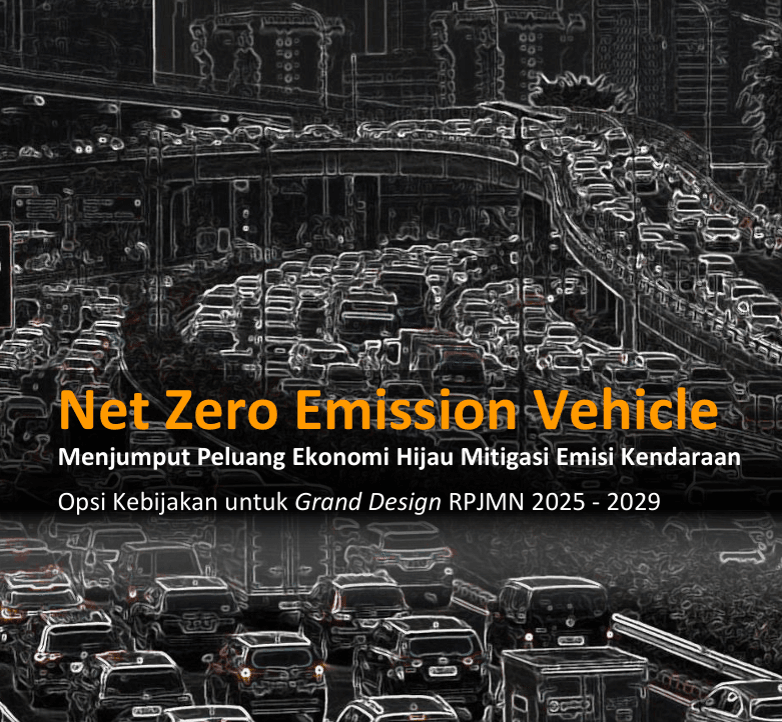
Statistics on the growth of motor vehicles in Indonesia tend to increase which has a negative impact on emissions, and
energy depletion. The technical scenario in the Low Carbon Emission Vehicle (LCEV) Standard shows the possibility to
reduce .280 GtonCO2e (59%) from .470 GtonCO2e of BAU vehicle emissions by 2030 referring to the baseline of .105
GtonCO2e (2010). The scenario also shows that we can derive USD 341.00 billion of economic benefits from fuel
efficiency, production savings, and improved public health along with improved air quality. In the context of fuel
efficiency, it can save up to 59.86 million KL p.a. gasoline, and 56.00 million KL p.a. diesel or equivalent to ~ USD 52
billion p.a. in 2030.
The technical scenario must be implemented by adopting the LCEV standard until 2030, Indonesia's NDC (National
Determination Contribution) timeline with a roadmap of 118 grCO2/km in 2023, and 85 grCO2/km in 2027. Whatever
the technology choice (ICE tech, BEV, PHEV, HEV, FC), these standards must be followed up with fiscal policy with a
feebate/rebate scheme that has been discussed since 2013, but has not been adopted when ratifying PP No. 41/2013
and PP No. 73/2019 or PP No. 74/2021, due to strong interest from the auto-industry. By preparing a fiscal policy,
efforts to change this policy can be focused on the government's willingness to accelerate battery-based EVs (BEV) as
mandated by Presidential Regulation 55/2019. Fiscal policy will trigger penetration of the Electric Vehicle (EV) market
by creating a more competitive EV selling price, in accordance with its ability to meet carbon standards, compared to
rather than ICE's technology.
As a direction setter, we need to carry out activities with the aim of (1) to reform policies and regulations, especially on
the fiscal policy, and LCEV standards mentioned above; (2) conduct effective public communication; (3) TA policy
analysis, and building an appropriate ecosystem for LCEV/EV, including preparing for a quick win by aligning electric
2-3-wheeled vehicles as the main technology driver for EV market penetration in Indonesia.
We already have a regulatory umbrella as mentioned above, in addition the capital in term of 40 EV prototypes including
2-3 wheels, buses and passenger vehicles; e-Bus trial; construction of charging facilities, communication processes, etc.
For this reason, CWF or ClimateWorks Foundation supports to facilitate KPBB in conducting advocacy and assistance
processes to related parties regarding the setting of LCEV standards, and fiscal policies with the aim of accelerating the
LCEV deployment by triggering electric 2-3-wheelers vehicle; as the main driving technology for the electrification of
road transport. Of course, this effort is a complement to previous efforts in assisting the electrification of BRT and its
feeders in DKI Jakarta, and other cities, including the initiation of the development of an electric vehicle integrator
company with pioneer PT INKA.
The most ambitious policy targets that can be achieved are the LCEV standard, and fiscal policy with a feebate/rebate
scheme. And based on experience, this can be achieved through technical, policy formulation, and support system work,
which will work closely to oversee key engagement and consensus with relevant stakeholders including the government
(Ministry of National Development Planning, Coordinating Ministry of Economic Affairs, Coordinating Ministry of
Maritime Affairs and Investment), Ministry of Industry, Ministry of Energy and Mineral Resources, Ministry of
Transportation, and Ministry of Environment and Forestry, Ministry of Finance, and non-state actors (2-3 electric
vehicle manufacturers: Gesits, Volta; e-bike manufacturer/production mass: U-Bike, Polygon; electrified 4-wheel vehicle
manufacturers: Bakri Otopart/BYD, Tesla, MAB, Higer, MAN, Hyundai, Nissan, etc.; and other supporting
manufacturers such as Bosh, Indonesia Battery Corporation, etc.); and CSOs and universities: IESR, ICCT, Traction
Energy, Madani, WWF, WRI, University of Indonesia, Bandung Institute of Technology, etc.
To accelerate the implementation of the mandate that has been issued by the President as mentioned above, it is time to
(1) issue the LCEV standard, fiscal policy, and roadmap, (2) increase prime-mover LCEV technology by choosing 2-3
wheelers electric vehicles, which is currently the most strategic vehicle segment (cheaper/affordable, popular, agile
maneuver, effective mobility tool).
Jakarta, 31 July 2022

Jakarta • 30 Juli 2022
Triggering A Strategic Things of e-2-3 Wheelers
Share to
Download Publikasi
Klik untuk Mengunduh Laporan

Author
kpbb cms 30 Juli 2022